

Plant Care
Water and Air: How a Self-Watering Planter Works
A reservoir is only part of the story. The wick moves water, while the planter’s openings make space for airflow around the planting area.

A self-watering planter is easy to describe as a pot with a water reservoir. But stored water is only one part of the design.
In VerdiPot, water and airflow are considered together. The wick connects the reservoir to the potting mix. Openings in the planter’s structure let air reach around the planting area. The exterior is involved in that work; it is not simply a decorative cover placed around a functional pot.
Water moves through the wick
The wick provides a path from stored water into the potting mix. It needs contact with both for the connection to work. Refilling the reservoir restores the water supply; it does not change the needs of the plant above it.
This is a passive system, not a moisture sensor that measures each plant and dispenses an exact dose. A plant in a cooler, dimmer position and one growing actively in brighter conditions should not be assumed to use water at the same rate.
That is why a reservoir should be observed alongside the mix and the plant. It makes water available between refills, but “self-watering” does not mean “never needs checking.”
Air is part of the structure
Water is not the only thing roots need. Prolonged waterlogging can reduce oxygen in the growing medium and damage roots, as described in the Missouri Botanical Garden’s watering guidance.
VerdiPot’s tabletop designs pair a perforated air-pruning inner pot with a ventilated exterior. The air-pruning design gives roots access to air at the pot’s openings rather than keeping them behind a continuously closed container wall.
A solid cover around those openings would work against that intention. In VerdiPot, the visible outer structure is designed to preserve airflow around the inner pot.
The open lattice of Koshido makes this especially easy to see. Lina expresses the same idea more quietly: its grooves form part of the exterior’s ventilation structure, rather than serving only as surface decoration.
The wall planter solves the same problem differently
Adding a separate inner pot would take up space inside a compact wall-mounted form. Our wall planters therefore use a planting chamber without a removable liner, together with a built-in water reservoir and wick.
Two long slots, one along each side, provide ventilation beyond the relatively small planting opening. This allows the exterior to retain its compact shape while giving air another route into the planting area.
The purpose is to balance moisture retention with ventilation—not to promise that every plant and every potting mix will stay at an ideal moisture level without attention.
The potting mix is part of the system too
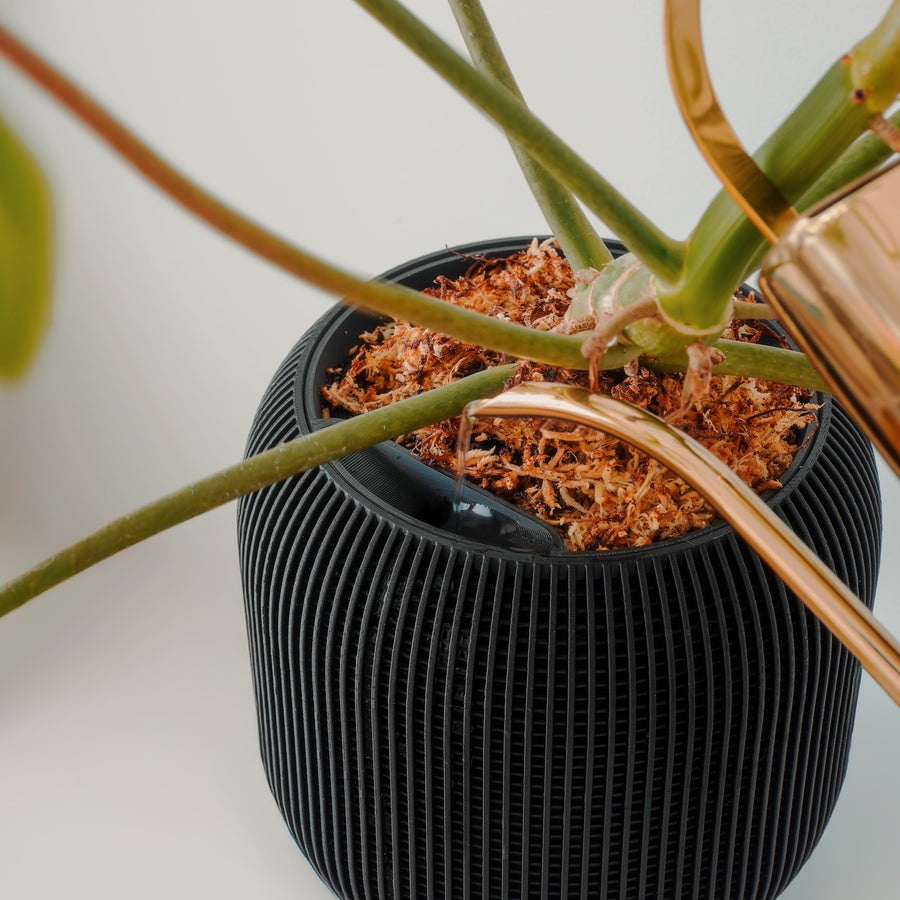
The wick, the growing medium and the surrounding air work together. A reservoir cannot make an unsuitable mix appropriate for a particular plant, and extra ventilation does not remove the need to check moisture.
If the mix is remaining wetter than the plant needs, adding more water is not the answer. Review the growing conditions and the setup rather than assuming the reservoir should always be topped up.
Likewise, water visible in the reservoir does not prove the wick is making good contact with the mix. When something seems wrong, check the connection before changing several parts of the routine at once.
A form with a purpose
The lattice, grooves and openings are among the first things people notice about VerdiPot. Their role is both visual and practical.
They let light shape the object you see, while helping keep air part of the space the plant grows in. That relationship—between the needs of roots and the character of a room—is the starting point of the design.