

Plants & Spaces
Pairing Plants and Planters: Shape, Color, and Proportion
Three pairings from the VerdiPot archive show how foliage, color and the lines of a planter can change the character of a small arrangement.

A plant and a planter can share a color, echo a shape, or create a useful contrast. The most interesting pairing is not always the closest match.
Before thinking about a room, look at the two objects together. Which lines repeat? Where does the eye pause? Does the planter give the foliage a background, or become part of the main gesture?
These pairings come from the VerdiPot archive. The original plant bundles are no longer offered; the photographs remain as references for choosing combinations of your own. They are examples of visual relationships, not a guarantee that the same setup will suit every growing environment.
Hoya australis ‘Lisa’ with Reflection
In this pairing, green and cream leaves sit above a white Reflection planter. The pale container relates to the lighter areas of the foliage without copying its pattern.
Reflection’s repeated geometry gives the arrangement a clear base. The leaves break away from that order, with changes in angle and color that feel more noticeable against the white form.
The effect comes from allowing one part of the pairing to be structured and the other to be irregular. When foliage is already detailed, the planter does not need a competing color contrast to be interesting.
Try this as a design principle: find a quieter color within the plant, then let the container pick it up. The connection can be subtle rather than exact.
Streptocarpus ‘Falling Stars’ with Hanaire
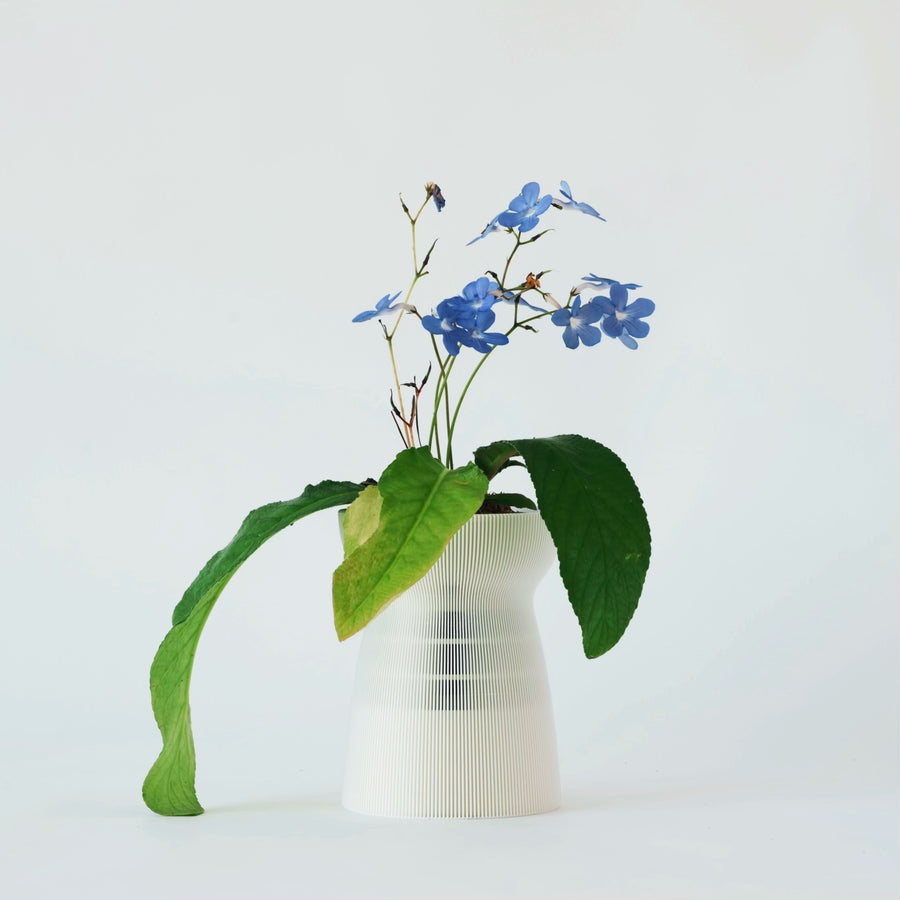
The archive photographs place blue-toned flowers and broad green leaves in white Hanaire. Its vase-like outline makes the pairing read a little like a flower arrangement, while the leaves spread beyond the container.
The white form leaves room for the flowers’ color. Its taller profile also creates a different balance from a low, wide bowl: the plant appears to emerge from a vessel rather than rest on a platform.
Notice how the outline matters even where foliage overlaps it. A planter does not need to be fully exposed for its proportions to influence the whole arrangement.
When working with flowers, decide whether the container should echo their color or offer a quieter setting. Both can work; combining strong color with strong surface detail is simply a more deliberate choice.
Labisia with Koshido—and with Lina
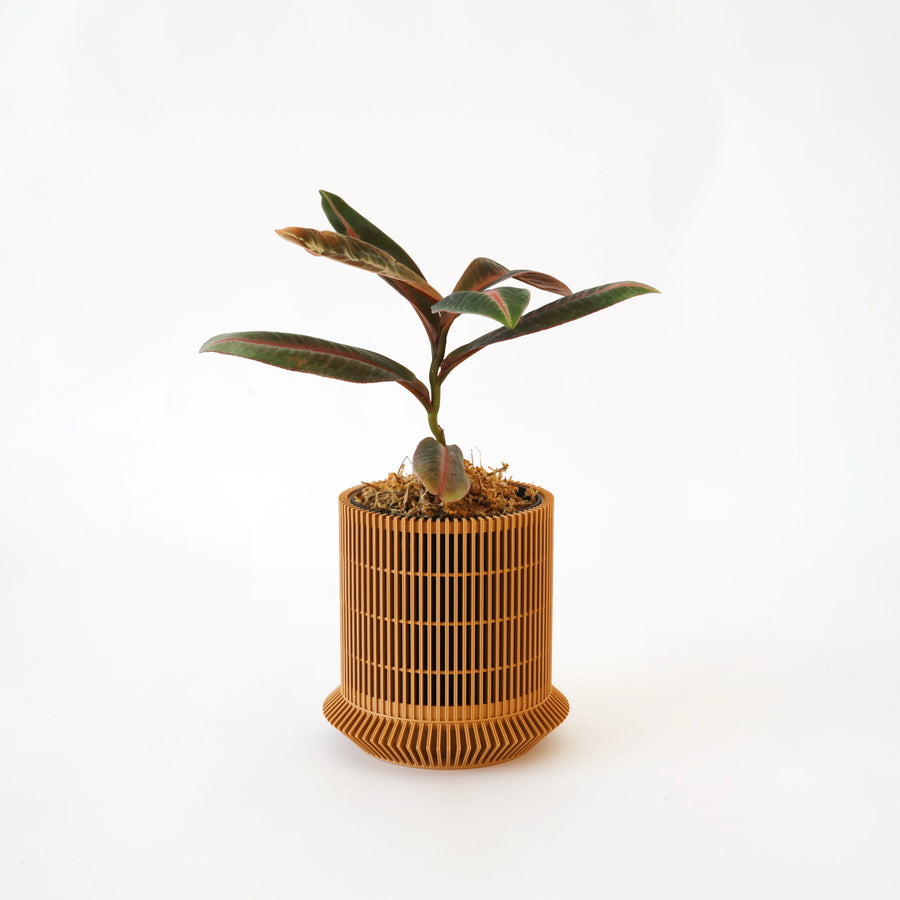
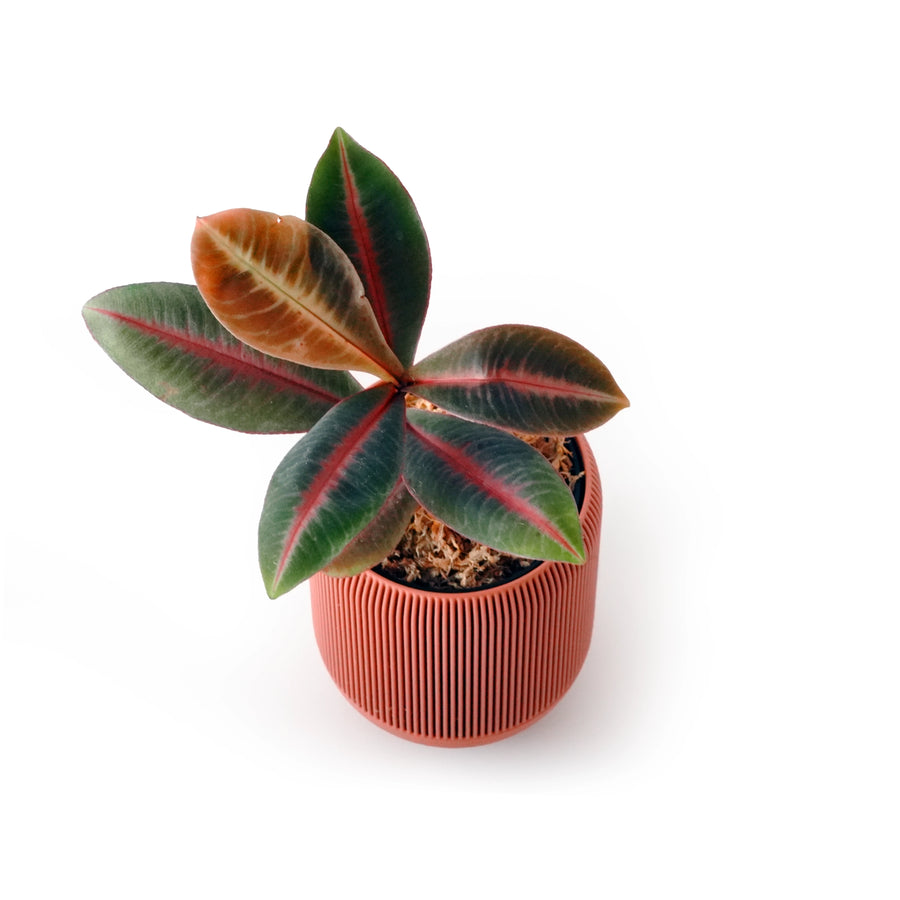
The Labisia photographs offer two useful directions. Warm-toned Koshido places a regular lattice beneath the plant’s red-veined leaves. Terracotta Lina brings the warmth into a more continuous, softly grooved form.
With Koshido, the contrast is between open structure and broad leaves. The fine vertical rhythm gives the foliage something precise to sit above.
With Lina, the relationship is more about color and volume. The warm exterior relates to the leaf veins, while the simpler outline lets the plant carry more of the visual detail.
Neither is the correct answer. One pairing emphasizes the construction of the container; the other makes the plant and planter feel closer in color and mass.
Set the visual choice inside a practical one
Begin with suitable growing conditions and planting dimensions. Then decide which expression you prefer. A beautiful exterior is not a reason to force a root ball into the wrong space.
Check inner and outer dimensions, and allow for the mature direction of the leaves. A small plant in an image will not necessarily remain a small plant in your room.
There is no fixed plant-to-pot ratio that makes every combination work. Look instead for intention: an echo, a contrast, a repeated line, or simply enough space for each part to be seen.
The planter can remain the steady part of the arrangement. The plant will keep changing it.